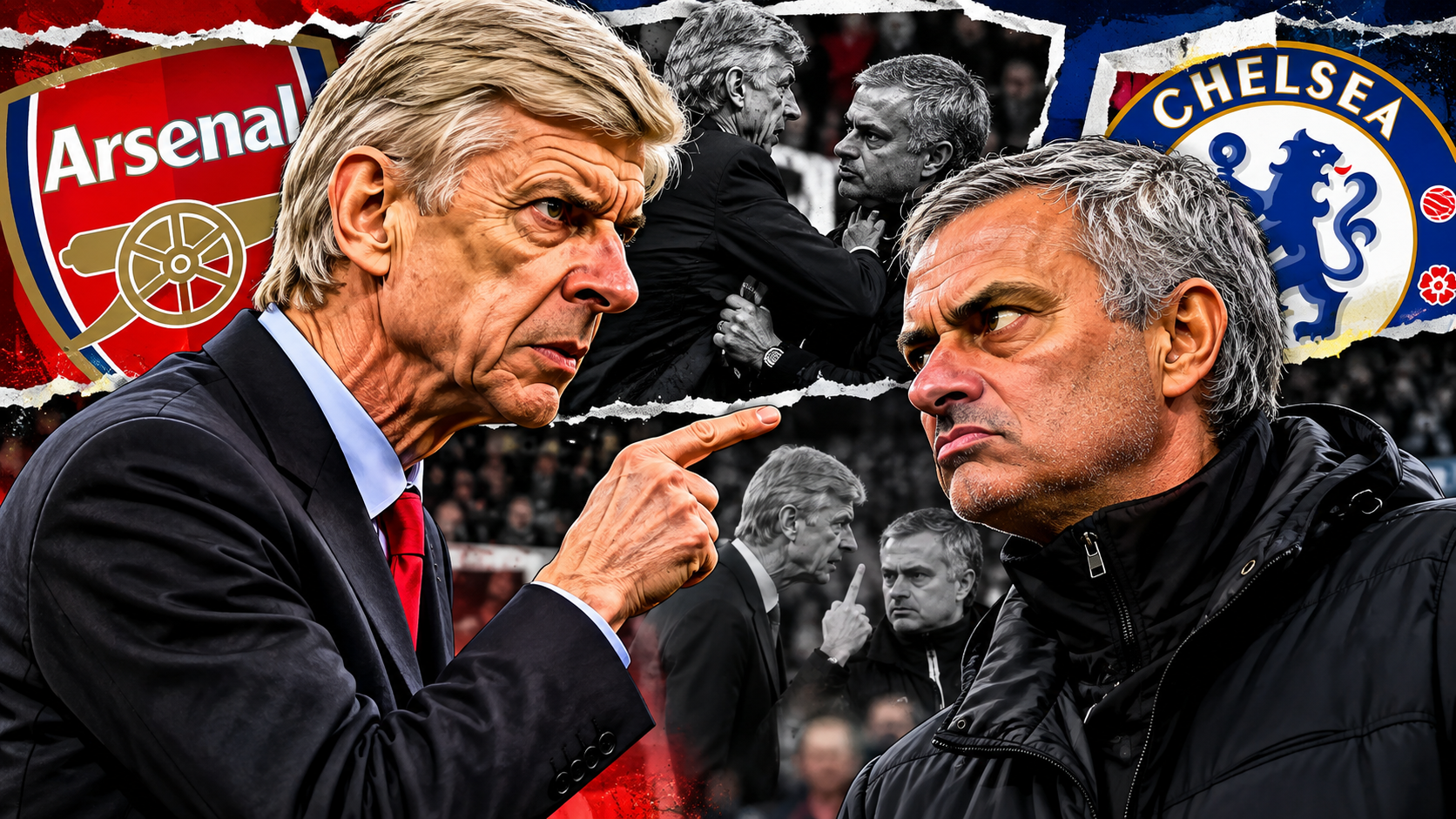
The Wenger-Mourinho rivalry grew from a sporting disagreement into something much more heated, largely because the two managers challenged each other’s ideas, status and authority. Arsène Wenger had already reshaped Arsenal by the time José Mourinho arrived at Chelsea in 2004.
The Portuguese coach then entered English football with a huge Champions League reputation and little interest in respecting the old order. Their teams competed for major honours, yet the real tension often played out in press conferences, on touchlines and through carefully chosen comments.
Wenger had spent years building an image as an intellectual coach who valued attacking football, technical quality and youth development. Arsenal’s transformation during his early years helped create that reputation. The Invincibles season in 2003-04 strengthened that identity.
Mourinho built his reputation around tactical organisation, defensive discipline, aggressive game management and control of the emotional side of matches. Results mattered most. Style came second.
That contrast gave their meetings an extra edge. Wenger could see Chelsea’s spending as part of a football culture he questioned, while Mourinho could challenge Arsenal’s idealism whenever results did not match the quality of the football. Each manager had a different idea of what elite coaching should look like. The press turned each meeting into a recurring contest long before kick-off itself.
Why did the Wenger-Mourinho rivalry become so personal?
The rivalry carried a generational and cultural clash. Wenger, the older Frenchman, spoke several languages and often approached football through ideas, systems and long-term development. Mourinho, younger and more theatrical, used personality as part of his managerial armoury. His famous “Special One” introduction immediately announced he wouldn’t arrive quietly.
The 2005 “voyeur” episode pushed the relationship into genuinely personal territory. Wenger had repeatedly discussed Chelsea’s approach, spending and tactics. Mourinho responded by calling the Arsenal manager a “voyeur” who spent too much time watching Chelsea. Wenger considered the remark offensive enough to raise the possibility of legal action. The exchange changed the tone. Football disagreement had become personal criticism.
Results made the rivalry even harder for Wenger to escape. Mourinho’s Chelsea regularly frustrated Arsenal, and the Portuguese coach went unbeaten in his first 13 meetings with Wenger before Arsenal finally won the 2015 Community Shield. The statistic became a weapon in itself. Every new meeting carried the memory of previous defeats.
The lowest point arrived during Wenger’s 1,000th Arsenal match in March 2014. Chelsea won 6-0 at Stamford Bridge, handing Arsenal their heaviest defeat against Chelsea. Arsenal conceded three goals inside the opening 17 minutes and spent most of the match chasing a result that had quickly disappeared. For Wenger, the occasion became a painful reminder of Mourinho’s advantage during their rivalry. The Premier League later described the defeat as a defining episode in the rivalry between the two managers.
Mourinho then delivered his most famous personal attack later that year. After Wenger suggested some managers feared failure when discussing the title race, Mourinho called him a “specialist in failure”, pointing to Arsenal’s long trophy drought. The remark struck at Wenger’s professional record rather than a particular tactical decision. It landed because Arsenal had gone nine years without a major trophy before winning the 2014 FA Cup.
The touchline confrontation at Stamford Bridge in October 2014 showed how far things had gone. After Gary Cahill fouled Alexis Sánchez, Wenger left his technical area and moved at Mourinho. The two men confronted each other before Wenger pushed the Chelsea manager in the chest. Officials intervened quickly. Wenger later apologised and admitted that he should not have responded that way.
That incident mattered because it stripped away the polished public image both managers usually maintained. Wenger was known for calm analysis, while Mourinho often presented himself as someone who could control every detail of a contest.
The 2015 Community Shield finally gave Wenger a result he had chased for years. Alex Oxlade-Chamberlain scored as Arsenal beat Chelsea 1-0, giving Wenger his first victory against Mourinho after 14 attempts.
Did Arsenal’s identity make the feud more personal?
Arsenal represented more than a football team for Wenger. The club carried his ideas about development, style and patience, so criticism of the Gunners could feel like criticism of the principles he had spent years building. Mourinho attacked that record with the same intensity that Wenger used when questioning Chelsea’s methods.
That explains why the feud felt bigger than two managers arguing about tactics. Chelsea and Arsenal were competing for trophies, but their managers were defending different versions of football itself. The Blues under Mourinho often sought control through structure and discipline, while Wenger wanted his side to express technical freedom and attacking ambition.
Money added another factor. Chelsea’s ownership investment allowed Mourinho to assemble a squad capable of competing immediately, while Arsenal spent years balancing ambition with the financial demands of building the Emirates Stadium. Wenger frequently had to operate with tighter restrictions during that period. Mourinho could therefore attack Arsenal’s lack of trophies, while Wenger could question the conditions behind Chelsea’s success.
Time eventually softened the hostility. Wenger left Arsenal in 2018, while Mourinho continued his career elsewhere. Without regular league meetings, the need for public sparring faded. Mourinho later spoke with greater appreciation for Wenger’s contribution, and Wenger acknowledged Mourinho’s quality as a coach.
Their relationship never became a simple friendship story. Too much history sat between them for that. Yet distance changed the meaning of the rivalry. What once looked like a personal war became a remarkable chapter in Premier League history, shaped by competing ideas, repeated confrontations and two managers who refused to surrender ground.
The Wenger-Mourinho rivalry became so personal because neither man treated football as a purely technical job. For Wenger, it involved identity and principles. For Mourinho, it involved competition, control and winning. Every match gave those beliefs another stage, and every argument carried the memory of the last one. That is why a rivalry that began with football eventually became something far more difficult to contain.