
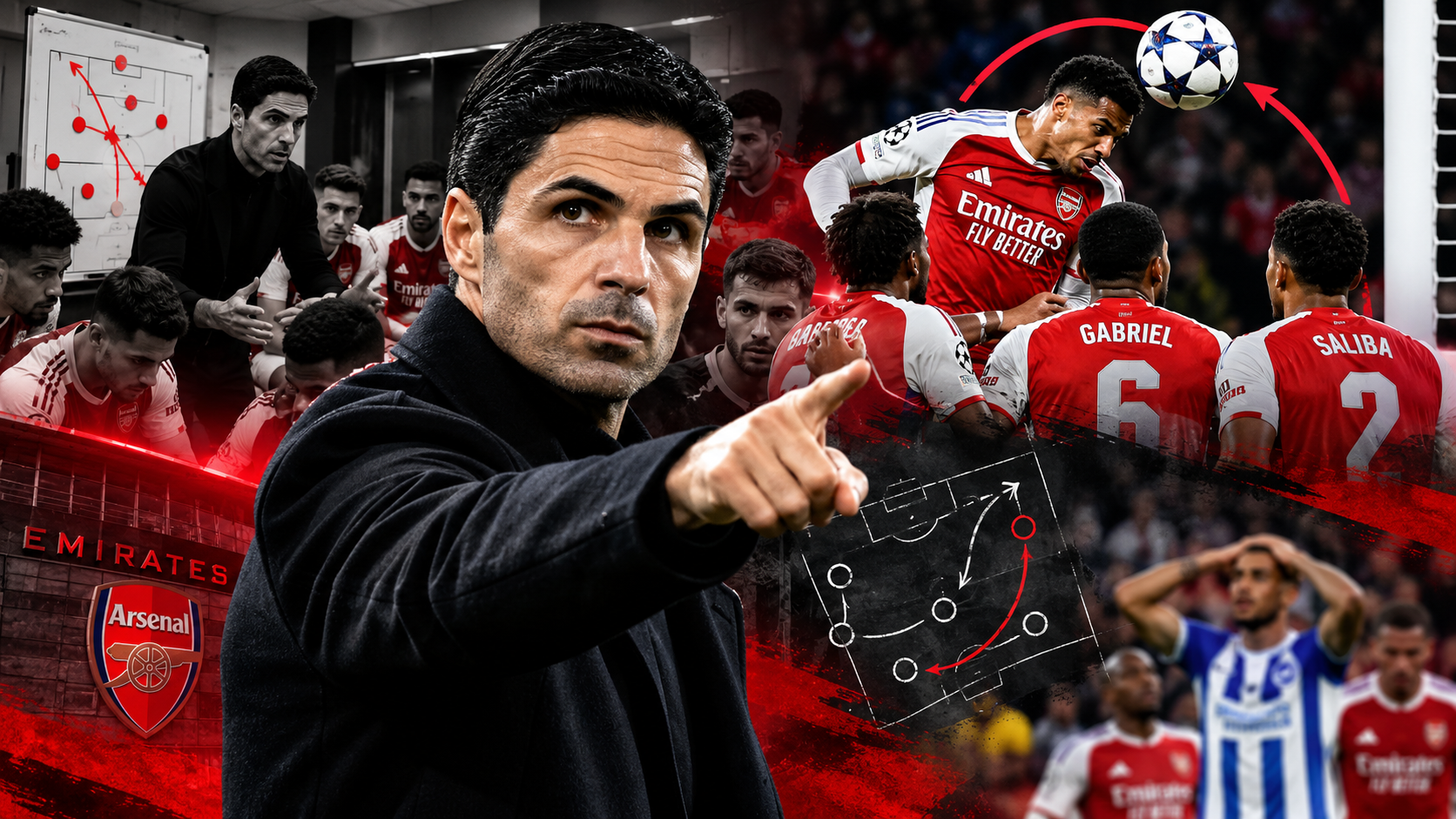
Arteta tactics began with order. Granit Xhaka recalled one of his first messages: scattered chairs had to return to their proper places, then stay there every day. Order came first. Arsenal‘s 2025/26 title and the opening weeks of 2026/27 show how far that idea has travelled.
Arsenal’s football now demands precision before expression. Chaos football suggests a side that welcomes broken shapes, loose possession and repeated transitions. Arteta has built something different. He wants his team ready for disorder, but on his terms.
Arteta tactics: Four unforgiving demands
1) Defensive spacing
The first demand is simple: attack only after the defensive structure has taken shape. Arsenal conceded 27 league goals in 2025/26 and kept 19 clean sheets, while their 8.2 shots faced per game and 0.7 expected goals against per match ranked first across Europe’s top five leagues. Those figures came from collective positioning rather than a goalkeeper constantly rescuing an exposed side.
The centre-backs hold their positions. Midfielders protect the space ahead of them. When possession breaks down, several Arsenal players already occupy useful positions for the next defensive action.
Arsenal may have opportunities to counter at speed, but they frequently refuse the first tempting pass if it would leave the rest of the defence vulnerable. Possession then becomes as much a defensive tool as an attacking one.
The contrast appeared in their title-winning campaign. Arsenal pressed aggressively and recovered the ball high, but with measured spacing. Their official review described the side as aggressive while stressing the discipline that protected David Raya.
The Champions League win at Napoli offered another example. Arsenal produced 26 shots and 4.05 expected goals, both club records for a Champions League match, while holding 57.7 per cent possession. They generated huge attacking volume without turning the match into a constant end-to-end exchange.
The same principle appears after Arsenal lose possession. Rather than sending everyone at the ball, the nearest players press while others close the obvious passing lanes. That split-second restraint matters because it stops one failed challenge from becoming a five-player chase.
It is why the system can look almost repetitive. The repetition is deliberate. Players know where the next man should stand, where the next pass should go and which spaces must remain protected. That clarity gives Arsenal a platform for risk without making risk the whole plan. That is the key difference in Arteta’s Arsenal.
That is Arteta’s version of control.
2) Set-piece planning
Set pieces provide the clearest evidence that Arsenal have reduced randomness. Nicolas Jover’s work has turned corners and free-kicks into rehearsed situations.
During 2025/26, Arsenal scored 25 Premier League goals from set pieces excluding penalties. 19 came from corners, a competition record. Those numbers gave Arsenal another route through matches in which open-play chances arrived slowly.
Arsenal can manipulate defenders before the ball leaves the taker’s foot. One player attacks the near post, another blocks a marker, another waits for a second phase. The starting positions give the players a clear script.
That approach sits neatly beside Arteta’s wider philosophy. He doesn’t need every attack to become spontaneous. He wants repeatable advantages. A corner becomes a controlled attacking sequence rather than a hopeful cross.
3) First duel and second ball
Has Arteta really abolished chaos football at Arsenal?
Brighton’s 3-0 victory over Arsenal on 19 September exposed the standard from the other side. Arteta said his players lost the first duel and second ball, then failed to respect the principles required to escape Brighton’s man-to-man pressure.
Arteta doesn’t judge a match solely through possession, territory or passing numbers. He expects players to win the physical contests that keep the structure alive.
Brighton attacked Arsenal with intensity and forced mistakes during build-up. Once Arsenal lost those early battles, their neat positions became far less useful because the next action arrived before they could reset.
That defeat does not prove chaos has returned. It shows what happens when Arsenal fail to control the conditions they usually control. The system needs every player to compete for the first contact, react to the second ball and make the next pass quickly.
There is little room for a passenger.
Arteta has spoken about man-oriented pressing in English football. Teams now chase Arsenal’s defenders and midfielders across the pitch rather than simply protecting a fixed block.
The Brighton result made the point brutally clear. Arsenal’s principles remained clear; their execution collapsed.
4) Ugly-minute management
Title-winning teams cannot expect every match to follow the preferred script. Arsenal won eight Premier League games 1-0 last season and collected 14 victories by one goal, matching their total from the 2003/04 title campaign.
The Sunderland win in September provided a fresh example. David Raya saved Enzo Le Fée’s penalty, Arsenal absorbed pressure, then Bruno Guimarães scored before Bukayo Saka added a late penalty. Arteta later spoke about accepting difficult moments inside the box and suffering through them.
That is not chaos football in the old sense. Arsenal did not chase every loose moment. They survived it, stayed organised and waited for their chance.
Selection follows the same principle. Guimarães arrived from Newcastle for £75 million, yet Arteta had already trusted Myles Lewis-Skelly in midfield alongside Declan Rice. A major signing does not automatically rewrite the hierarchy. Players have to meet the demands of the position.
Arsenal’s summer business added experience, competition and different physical qualities; status carries less value than tactical usefulness.
Not entirely. He has said he wants Arsenal to become the best team in chaotic moments, which is different from eliminating disorder. Football cannot be sterilised. Deflections happen. Second balls fall awkwardly. Referees make decisions, crowds change momentum, and opponents create situations no coach can fully script.
What Arteta has changed is Arsenal’s relationship with those moments. The team tries to reduce their frequency, prepare for them and respond without abandoning its shape.
That distinction explains the four demands. Protect the space behind the ball. Treat dead balls as rehearsed opportunities. Win the first duel and second ball. Then survive the ugly passages with players capable of keeping their heads.
Arsenal’s 2025/26 numbers give the argument substance, while Brighton’s 3-0 win provides the necessary warning. The structure remains effective because the standards remain unforgiving.
My view is that calling this the death of chaos football goes too far. Arteta tactics have made control the default and chaos a situation Arsenal must learn to manage. Brighton showed that the difference between the two can disappear quickly when the first duel is lost and the structure cracks.