
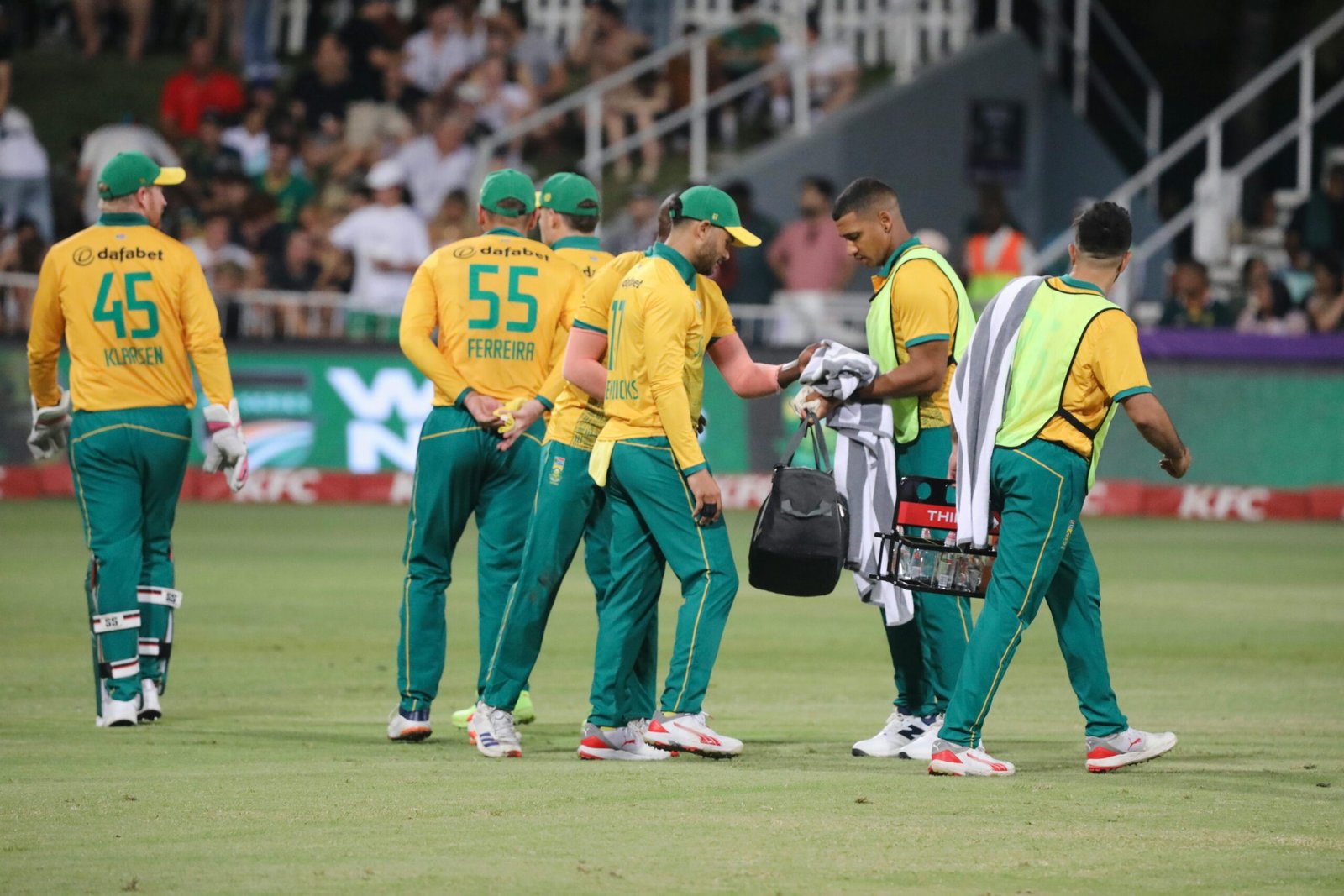
South Africa arrives at the ICC Men’s T20 World Cup 2026 carrying unfinished business. After falling painfully short in the 2024 final, the Proteas return with renewed intent, tough selection calls, and a squad explicitly shaped for conditions in India and Sri Lanka.
Once known mainly for pace and power, South Africa now arrive with a more balanced approach. Spin depth has been prioritised, youth has been trusted, and experience still anchors the core. While some omissions have sparked debate, the message from selectors is clear. This squad has been picked to win matches in Asian conditions, not to reward form alone.
Placed in Group D alongside New Zealand, Afghanistan, Canada and the UAE, South Africa face a tricky but manageable route. Qualification is expected, but dominance is far from guaranteed.
South Africa’s Road to T20 World Cup 2026: Rebuilding After Heartbreak
South Africa secured direct qualification for the ICC Men’s T20 World Cup 2026 by reaching the final of the 2024 edition. Despite losing the title match, their overall campaign confirmed them as one of the strongest T20 sides in the world.
The aftermath of that defeat triggered a reset. The selectors opted for a youth meets experience model, backing long-term potential over short-term reputation. Aiden Markram remains captain, trusted for his calm leadership and tactical acumen.
Preparation has focused heavily on adaptability. The decision to recall George Linde and rely on Keshav Maharaj as the lead spinner reflects a clear shift in thinking. The pace attack remains strong, but there is now greater emphasis on control through the middle overs.
The most significant talking point has been the omission of Tristan Stubbs and Ryan Rickelton, both in strong form. The selectors cited role clarity and suitability for the subcontinent as key reasons, even though the calls remain controversial.
Group D Challenge: Balance Over Brute Force
South Africa shares Group D with New Zealand, Afghanistan, Canada and the UAE. On paper, they are favourites to progress, but the group presents very different challenges.
Matches against Canada and the UAE are must-win fixtures. Afghanistan and New Zealand, however, will test South Africa’s adaptability, especially against spin-heavy attacks.
South Africa’s strength still lies in pace. Kagiso Rabada’s return from injury is a significant boost. Alongside Anrich Nortje, Lungi Ngidi, and Marco Jansen, South Africa possesses one of the fastest and most aggressive pace units in the tournament.
Batting depth remains a question. With David Miller as the senior finisher and Dewald Brevis stepping into a bigger role, the middle order must prove it can handle slow pitches and scoreboard pressure.
Spin will play a key role. Maharaj and Linde are expected to control the game through accuracy rather than turn, allowing quicks to attack at the start and end.
Venues, Conditions and Tactical Factors
All of South Africa’s group matches will be played in India, with three fixtures at Ahmedabad and one in Delhi.
Group stage schedule:
February 9: South Africa vs Canada, Ahmedabad
February 11: South Africa vs Afghanistan, Ahmedabad
February 14: South Africa vs New Zealand, Ahmedabad
February 18: South Africa vs UAE, Delhi
Ahmedabad offers bounce and carry under lights, which suits South Africa’s fast bowlers. However, day games could slow down significantly, making shot selection critical against spin.
The match against Afghanistan in Ahmedabad could be the toughest test. Afghanistan’s spinners thrive on extensive grounds and slow surfaces, directly challenging South Africa’s middle order.
Delhi’s Arun Jaitley Stadium often plays low and slow as tournaments progress. This will demand patience from batters and precision from bowlers like Maharaj and Linde.
South Africa’s ability to adapt match by match will decide whether they dominate the group or merely scrape through.
South Africa Squad for ICC Men’s T20 World Cup 2026
South Africa has named a squad that blends proven stars with emerging talent.
South Africa cricket team: Aiden Markram, captain, Quinton de Kock, Donovan Ferreira, David Miller, Dewald Brevis, Tony de Zorzi, Marco Jansen, George Linde, Jason Smith, Corbin Bosch, Keshav Maharaj, Kagiso Rabada, Anrich Nortje, Lungi Ngidi, Kwena Maphaka.
Notable omissions include Tristan Stubbs, Ryan Rickelton, Reeza Hendricks and Heinrich Klaasen, who has retired from international cricket.
South Africa enters the ICC Men’s T20 World Cup 2026 as one of the strongest teams on paper. Whether this squad can finally overcome pressure moments and fully adapt to Asian conditions will determine whether the Proteas end the tournament as champions or with familiar regret.